
Reproductive Maternal Newborn Child Adolescent Health Programme – Meet our Project Lead – Khadija Abbas Mohamed

Meet Our Project Lead - Khadija Abbas Mohamed
At the heart of HIPZ’s mission to improve healthcare in Zanzibar lies the Reproductive Maternal Newborn Child Adolescent Health (RMNCAH) Programme, a partnership with the Ministry of Health and the Lady Fatemah Charitable Trust, aimed at improving maternal and child health outcomes across Zanzibar.
Following the success of Phase 1, which focused on two districts, the programme has now embarked on a nationwide scale-up, known as MNCH Phase 2.

This three-year intervention is designed to strengthen healthcare infrastructure, improve the capacity of healthcare workers, and foster sustainable progress towards achieving the Sustainable Development Goals (SDGs) 3.1 and 3.2. The importance of this programme is ramified when considering that although there is a trend in decline in mortality of children, it is reported, for example, that 1 in 23 children do not reach their 5th birthday (TDHS-MIS 2022).
At the helm of this ambitious programme is Khadija Abbas Mohamed, a passionate Zanzibari healthcare professional whose background as a nurse, midwife, and public health specialist has positioned her perfectly to lead this transformative project. Khadija shared her story and experiences with us, giving us a glimpse into her journey, challenges, and successes.
A Zanzibari at Heart: Khadija's Journey
Khadija’s journey into healthcare began as a nurse-midwife at Mnazi Mmoja Hospital, where she conducted numerous deliveries and honed her clinical skills. After further education in Zanzibar and Dar Es Salaam, she earned a scholarship to pursue her Master’s in Public Health at the Royal Tropical Institute of Amsterdam (KIT), an experience she describes with fondness for its diverse cultures and community. Despite her international experience, Khadija’s heart remains in Zanzibar: “I love Zanzibar, so I had to come back and help improve healthcare, especially for mothers and children.”
In December 2023, Khadija joined HIPZ as the project lead for the RMNCH programme, funded by the Lady Fatemah (a.s.) Charitable Trust. Her work focuses on improving healthcare systems across Zanzibar, particularly in maternal and child health, with a strong emphasis on capacity building, leadership training, and improving data management systems.

The Impact of RMNCH Phase 2
Khadija’s role involves overseeing the MNCH Phase 2 Project, which began its implementation across six districts, focusing on 90 health facilities. We will be scaling up in the next year in both Unguja and Pemba.
Through training and leadership programmes, they aim to improve maternal and child health services, streamline data collection, and address critical gaps in healthcare delivery.
Our three key intervention points include: (1) training and leadership development by building the capacity of healthcare workers with technical skills such as labour, delivery, and postnatal care, as well as leadership and management training for healthcare workers and system managers; (2) improving medical supplies, infrastructure, and equipment, including maintenance support through our biomedical engineers; and (3) strengthening data collection, monitoring, and evaluation systems to track progress and enhance healthcare delivery.
In its first year, a total of 315 healthcare workers were trained (69.2% of all the targeted healthcare workers for the project). In addition, 142 health managers were trained (51.6% of the targeted managers). “We’re doing great—implementing almost all our plans for the programme, especially in capacity building for healthcare workers and leadership training. We’re also improving our data systems, making sure district data managers can capture accurate data, despite the challenges they face,” Khadija explains.
One of the challenges Khadija emphasizes is the shortage of healthcare workers: “You’ll sometimes find just one healthcare worker doing everything—delivering services, capturing data, and entering it into paper registers. It’s a heavy burden when accuracy and timeliness are so important.”
The programme is also addressing infrastructure issues: “There’s often just one bed for three mothers in postnatal wards. This lack of space impacts confidentiality, privacy, and service quality.”
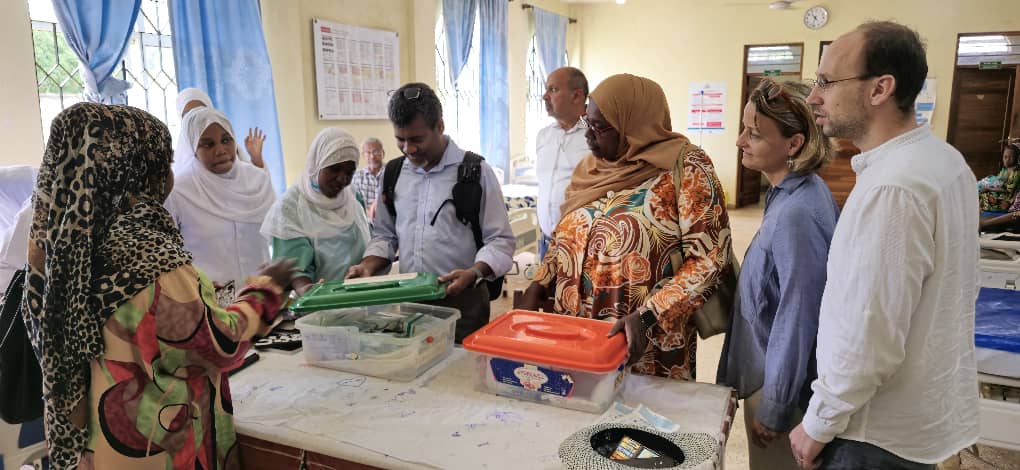
Building Capacity and Overcoming Challenges
We have built capacity in key healthcare areas, including antenatal care, labor and delivery, postnatal care, and neonatal and pediatric care, as well as in leadership and management for hospital managers and primary healthcare leaders. This training equips them with skills to effectively lead and manage their facilities. The programme has also trained healthcare workers in data management and quality assurance to improve patient record-keeping and health outcome monitoring.
In response to Zanzibar’s Ministry of Health’s focus on centralizing financial planning at each facility, we have provided training to ensure that healthcare leaders can plan, implement, and manage budgets effectively. We partnered with UNICEF to develop training materials and learner guides. Following a pilot programme, UNICEF led a Training of Trainers (TOT) session, and we conducted additional management training so that each facility is better equipped to operate independently in line with government strategies.
A significant focus has been on mentorship: “We’ve trained 40 healthcare workers in Unguja and Pemba to mentor others at the lower level, providing monthly support in maternal and child healthcare.”
Furthermore, the programme has hired consultants in gynaecology and paediatrics who rotate between district hospitals, providing specialist care and supervising junior doctors, as well as two midwife specialists who also provide mentorship. “We’ve seen great improvement—junior doctors are now able to perform more complex procedures thanks to the training they’ve received.”

Introducing Life-Saving Tools
One of the most impactful interventions has been the introduction of a blood collection drape for managing postpartum hemorrhage (PPH), a major cause of maternal deaths. “This simple tool has already been used in hospitals, helping save mothers’ lives by accurately estimating blood loss and managing PPH. It’s one of the clear improvements we’ve seen,” Khadija adds proudly.
We trained 35 mentors in Unguja and 36 in Pemba on using the drape and uterotonic balloon tamponade to identify and manage PPH. These mentors, in turn, trained other healthcare workers in their facilities to ensure everyone is equipped to use these devices effectively, helping prevent PPH and safeguard maternal health.
Looking Forward: Building a Sustainable Healthcare System
As RMNCH Phase 2 moves into its second year, Khadija remains optimistic: “The programme has done very well in its first year, but there is still work to do. Some interventions will need longer than three years to fully see the improvement and ensure sustainability.” We will now cover all 11 districts of Zanzibar, comprising a total of 199 healthcare facilities.
Khadija is also hopeful about the introduction of community healthcare workers, who will be trained to engage directly with communities, encouraging early clinic visits and improving postnatal care. “This strategy will improve services and ensure mothers and children get the care they need early on.”
The Lady Fatemah Trust continues to fund this vital programme, and Khadija is confident that, with time and continued support, the healthcare system in Zanzibar will grow stronger, providing better access and quality care to all.
We would also like to thank and acknowledge the Ministry of Health Zanzibar for their guidance and support provided to HIPZ with this programme.
HIPZ’s impact on maternal and child healthcare is profound, and through Khadija’s leadership, the programme is making tangible progress toward a healthier Zanzibar. “I feel positive, especially for the district hospitals. Thanks to HIPZ, people can access the care they need, and the system is improving every day.”
